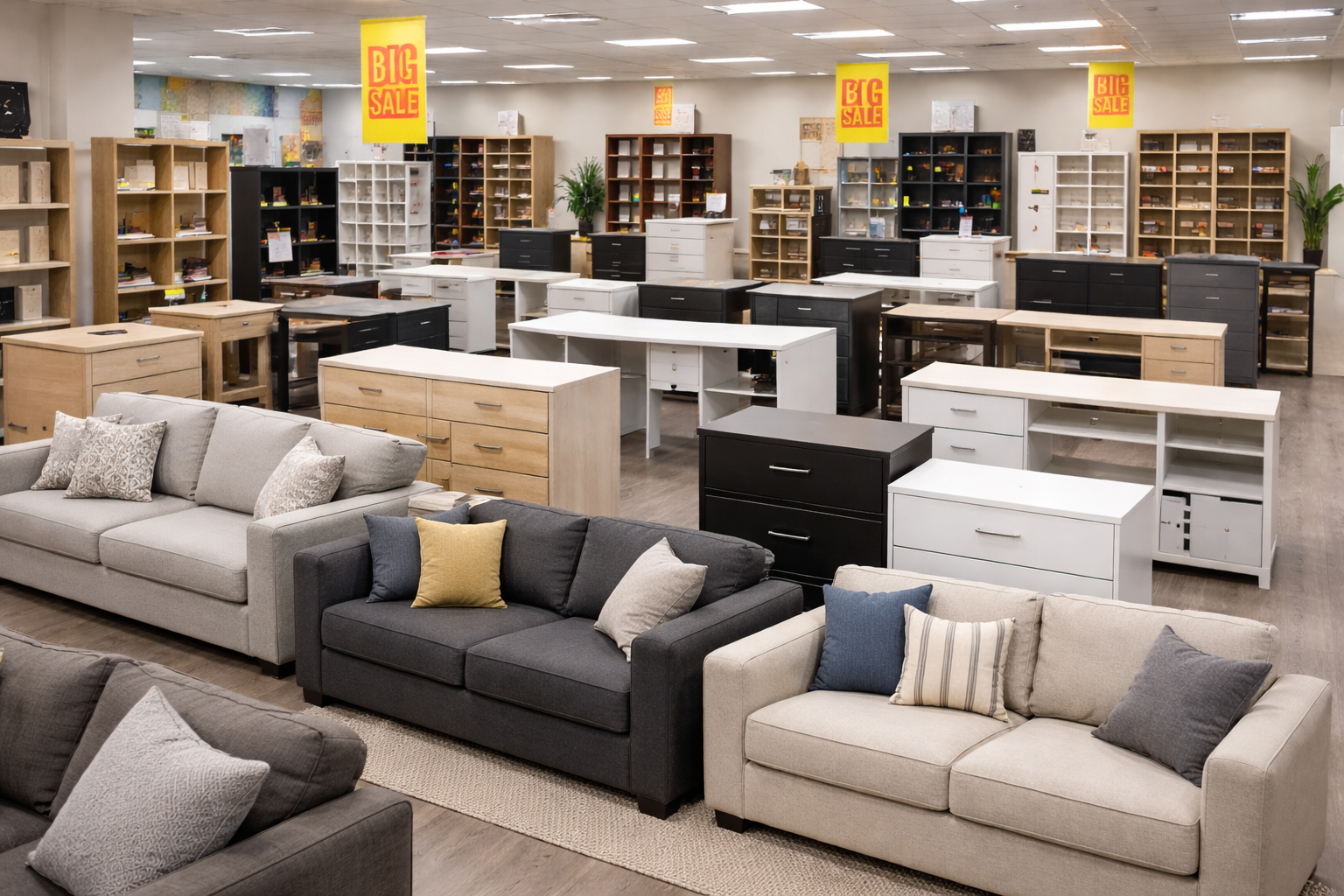
You’ve been there. You walk into a big furniture store, overwhelmed by the sheer volume of choice, and eventually settle on something that looks reasonable under the showroom lighting. It’s the right colour. The price is manageable. You tell yourself it’ll do.
It arrives flat-packed in six boxes. You spend a Sunday afternoon building it. And then you stand back and realise: it doesn’t quite work. The proportions are slightly off. It doesn’t fit the alcove the way you imagined. The finish looks different in natural light.
Within a year, a drawer is stiff. Within three, the joints are loose. Within five, you’re back in the store.
The problem isn’t your taste. It’s the model. Mass-produced furniture is designed to sell at scale — and that single priority shapes every decision made about it, from the materials used to the dimensions chosen to the finish applied. Understanding why it keeps disappointing is the first step to doing something differently.
Five ways mass-produced furniture falls short
- It’s built for the average room — not your room
Furniture manufacturers design for a statistical middle ground. Standard sofa depths assume standard room proportions. Wardrobe heights ignore the reality that ceilings vary. Shelf widths are set by what fits on a lorry, not what fits in your alcove.
The result is furniture that almost fits. And ‘almost’ is surprisingly hard to live with. A sofa that’s six inches too deep can make a medium-sized room feel cramped. A storage unit that’s two inches too narrow leaves a gap that collects dust and looks unfinished. These aren’t small aesthetic quibbles — they change how a room functions every single day.
- The materials are optimised for price, not longevity
Open the back of a flat-pack unit and you’ll usually find MDF — medium-density fibreboard — laminated with a printed wood-effect finish. It’s inexpensive to produce, consistent in size, and easy to cut. It is also heavy, prone to swelling when it gets damp, and impossible to repair once the surface is damaged.
Joints are typically held together with cam locks and wooden dowels rather than traditional joinery. Upholstery is often filled with low-density foam that compresses quickly. These aren’t flaws in the design — they’re deliberate choices made to hit a price point. The furniture is built to a budget, not to a standard.
- The style is designed to offend no one
Mass-market furniture aims for the broadest possible appeal, which means it tends toward the safe, the neutral, and the generic. Ranges are designed to look acceptable in any home, which means they rarely feel right in any specific one.
There’s nothing wrong with neutral — but there’s a difference between calm and characterless. If your furniture could belong to anyone, it doesn’t really belong to you. A home that feels genuinely personal is one where the choices — including the furniture — reflect actual decisions, not defaults.
- You pay more than you think, over time
The low upfront cost of mass-produced furniture is real, but it hides a longer-term calculation. A sofa that costs Rs.15000.00 and lasts five years costs Rs.20000.00 per year. A handmade three seater sofa that costs Rs. 135000.00 and lasts twenty-five years costs Rs. 5400.00 per year — and holds its character in a way the cheaper one never will.
Add in the hidden costs — delivery, disposal, the time spent choosing and assembling a replacement — and the economics of quality furniture look considerably more attractive. The cheapest option at the point of purchase is rarely the cheapest option over a decade.
- It creates waste that adds up
India generates approximately 3.1 million tonnes of furniture waste annually, which often ends up in landfills due to the rise of “fast furniture” made from low-quality, non-biodegradable materials. Much of it is less than a decade old. Fast furniture follows the same logic as fast fashion: low prices, short lifespans, high volumes of waste

This isn’t an argument for guilt — it’s an argument for thinking about furniture differently. A piece built to last, from materials chosen for quality rather than cost, is one that never needs to be thrown away. Durability and sustainability, in furniture, are the same thing.
Why modern homes make this worse
Contemporary homes — especially those that have been renovated or opened up — are less forgiving of generic furniture than ever. Open-plan layouts mean that multiple rooms are visible from a single vantage point, so a piece that doesn’t quite belong is immediately noticeable. Distinctive architectural features — a Victorian bay window, a converted loft, a low ceiling with exposed beams — demand furniture that responds to them.
There’s also the question of how we use our homes now. The shift toward working from home has fundamentally changed our relationship with domestic space. Furniture that was tolerable when you spent ten hours a day outside the house becomes a daily frustration when you’re in it all week. A desk that’s slightly wrong, a chair that’s slightly uncomfortable, storage that almost-but-not-quite works — these things compound.
The modern home demands more of its furniture. Mass production, which has always struggled to deliver quality and fit, is less equipped than ever to meet those demands.
What to do instead
The answer isn’t simply to spend more money. It’s to think about furniture differently — to shift from a consumption mindset to an investment one. Here’s what that looks like in practice.
Buy fewer, better pieces. One quality item that lasts a generation beats three mediocre ones you replace every few years. A smaller number of considered choices creates a more coherent home, too.
- Prioritise the pieces you use most. Your sofa, your dining table, your bed, your primary storage. These are where you spend the most time and where quality makes the most difference. Start here.
- Consider custom for the pieces that need to fit. Alcove shelving, fitted storage, window seats, home office solutions — these are problems that off-the-shelf furniture simply cannot solve. Custom isn’t a luxury for these; it’s the only thing that actually works.
- Think in decades, not seasons. Furniture trends cycle quickly. Well-crafted pieces in natural materials — solid wood, quality upholstery, hand-finished surfaces — age gracefully. They don’t date the way trend-led pieces do.
Custom, handmade furniture is not about spending more for the sake of it. It’s the logical conclusion of taking the long view. A piece made specifically for your space, your dimensions, and your taste is one that earns its place in your home for years to come — and one that you’ll never need to replace with another flat-pack substitute.
Ready to think differently?
If you’ve been through the cycle — bought the flat-pack, watched it deteriorate, replaced it, repeated — you already know the cost of the cheaper option. The good news is that doing things differently is simpler than it sounds.
Custom furniture isn’t more expensive. Replacing cheap furniture repeatedly is.