Most people who want custom furniture don’t commission it. Not because they can’t afford it, and not because they don’t genuinely want it. They don’t commission it because the process feels opaque.
What happens after you make contact? How many decisions will you need to make, and when? How long will it take? What if you don’t love the result? These are reasonable questions, and the fact that they’re rarely answered upfront is one of the main reasons people hesitate.
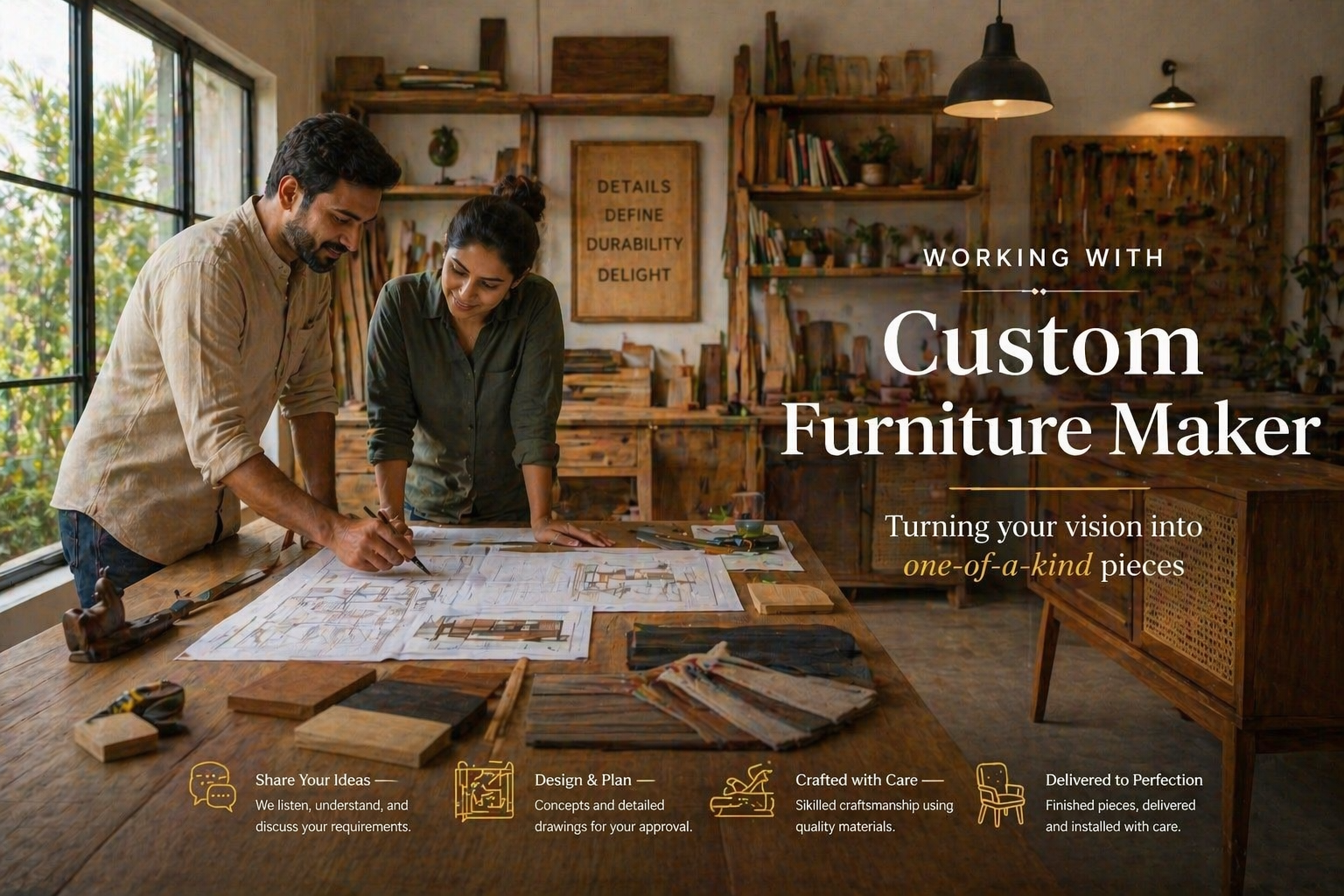
This article is a straightforward walkthrough of the entire process — from first conversation to finished room — so that by the time you reach the end, commissioning custom furniture feels like what it actually is: a clear, collaborative, and mostly enjoyable process. Just different from buying off a shelf, and different in ways that are almost entirely positive.
A typical commission moves through five stages over eight to twelve weeks. Complex or multi-piece projects take longer.
Stage 1 The initial consultation
The first conversation is not a sales pitch — or it shouldn’t be. It’s a mutual assessment: the maker is trying to understand the space, the brief, and the person; the client is trying to understand whether this is someone they trust with their home. Both things matter equally.
Consultations happen in person, over the phone, or via video. There is no single right format. An in-person consultation in the actual space has obvious advantages — the maker can see the room, note the light, observe the architectural details that don’t come through in photographs. A video call works well for clients who want an initial conversation before committing to a visit.
What to bring
- Rough measurements of the space (if available or 2d room layout)
- Photographs of the room from multiple angles
- Any reference images that capture the style or feel you’re after — saved posts, magazine pages, mood boards. Nothing is too informal
- A sense of what isn’t working about the current setup — this is often more useful than knowing exactly what you want
A good maker will ask more questions than they answer at this stage. How is the space used? Who uses it? What are the priorities — storage, aesthetics, durability, all three? What has been tried before and why didn’t it work?
What you will not get at the end of a consultation is a price. The consultation is about understanding the brief clearly enough to design against it. A price comes once the scope is defined. And there is no obligation after a consultation — it is a conversation, nothing more.
Stage 2 The design and proposal
Once the brief is understood, the maker translates it into a concrete proposal. This is where the piece moves from a conversation into something you can see, touch, and react to.
A thorough proposal includes scale drawings or sketches showing the proposed piece in the context of the room, material samples — wood species, fabric swatches, hardware options — to hold and consider in the actual space, and a written quote that itemises clearly what is included.
For a straightforward commission, the proposal typically arrives within one to two weeks. For complex multi-piece projects or fitted work, allow longer.
The most important stage in the process
This is where the piece gets refined from a good idea into the right piece — and it deserves proper attention. Review the drawings carefully. Hold the material samples in the room at different times of day. Ask questions. Request changes. Everything at this stage is easy to adjust; once production begins, changes become costly and sometimes impossible.
A common mistake: approving a proposal quickly because the overall direction feels right, without scrutinising the details. The details — the exact dimensions, the hardware choice, the fabric grade — are what you will live with every day. They are worth the time.
Once the design is agreed and the drawings are signed off, a deposit — typically 50% of the total — secures the build slot. The remainder is due on delivery.
Stage 3 The build
The piece is made, by hand, in the maker’s workshop. For the client, this stage is mostly a matter of waiting — but it’s worth understanding what is happening during that time, because it explains both the lead time and the result.
A single bespoke piece — a dining table, a fitted wardrobe, a set of alcove shelves — typically takes four to eight weeks in production, depending on complexity and the maker’s current schedule. Multi-piece commissions or fully fitted projects take longer. These are honest figures, not estimates padded with contingency.
Staying in the loop
A good maker will keep you informed during the build. A mid-production update with workshop photographs is standard practice — it’s reassuring to see the piece taking shape, and it’s an opportunity to raise any questions before the build is complete. Some makers welcome clients to visit the workshop; it’s worth asking.
On lead times
The lead time is not a inconvenience to be minimised. It exists because the piece is being made specifically for you, by skilled hands, using proper materials and traditional joinery. It is the direct evidence of the care being taken. A custom furniture maker who can deliver in a week is not working to the same standard as one who needs eight.
One practical note: for homeowners working to a renovation timeline, this lead time needs to be planned for. Ordering custom furniture at the end of a project rather than the beginning is one of the most common causes of delay. If you know you want custom pieces, commission them early.
A note on natural variation • Wood grain, colour, and texture vary naturally between pieces — even pieces cut from the same tree. This is not a flaw. It is the material. A slight variation in grain direction, a mineral streak in the wood, a subtle difference in tone between boards — these are the qualities that distinguish a handmade piece from a manufactured one. Embrace them. |
Stage 4 Delivery and installation
A custom furniture delivery is not a flat-pack drop-off. For large or fitted pieces, the maker or their team will typically deliver and install the piece themselves — ensuring it fits correctly, sits level, is properly secured where needed, and is finished to the same standard as the piece itself.
This is the moment where thorough preparation pays off. If the measurements were taken carefully, if access constraints were communicated clearly, and if the proposal was reviewed properly, nothing at delivery should come as a surprise. The piece should arrive, fit, and look exactly as anticipated — or better.
Snagging
Before the maker leaves, walk through the finished piece together. Check drawers and doors. Look at surfaces in natural light. Check that the piece sits level and is properly secured. Any minor issues — a drawer that needs a small adjustment, a surface mark from transit, a hinge that isn’t quite flush — should be noted and addressed. A good maker will fix these on the day or at a brief follow-up visit, without hesitation and at no additional cost.
This walkthrough is not adversarial — it’s collaborative. The maker wants you to love the piece as much as you do. A thorough snagging process is in everyone’s interest.
Stage 5 Aftercare
Custom furniture is a long-term relationship, not a one-time transaction. A good maker doesn’t disappear after delivery.
Proper aftercare includes clear guidance on maintaining the piece — oiling schedules for solid wood, conditioning for leather, cleaning recommendations for upholstery. It includes availability for questions after the piece is in place. And it means a willingness to return for any adjustments that emerge over the first weeks of use.
This is an area where a small, independent maker has a significant structural advantage over a large manufacturer. They know exactly what they made, how they made it, and what materials were used. They are personally accountable for the quality of the work in a way that a customer service department operating from a script never can be.
A good first commission also tends to be the start of something longer. Clients who find a maker they trust rarely go anywhere else.
What if something goes wrong?
Things occasionally go wrong in any bespoke process. A finish arrives slightly different from the sample. A dimension is a few millimetres off. A fabric has a subtle colour variation that wasn’t apparent in the swatch. These things happen, and they are not reasons to avoid commissioning custom furniture.
What distinguishes a good maker is how they respond. Promptly, without argument, and at no additional cost to the client. The standard should be: the piece meets the agreed specification, and if it doesn’t, the maker fixes it.
Before commissioning, it’s worth asking directly about a maker’s approach to snagging and aftercare. How they answer — and how specific they are — will tell you a great deal about how they operate.
What to look for in a maker
Not all custom furniture makers operate to the same standard. Here are the indicators that matter when making your choice.
Green flags• A clear, transparent process explained upfront — before you ask • A portfolio of completed work shown in real client contexts, not just isolated product shots • Willingness to provide references from previous clients • Honest lead times — accurate rather than optimistic • Clear, proactive communication throughout the process • A written proposal and formal sign-off before production begins • Specific, detailed answers to questions about materials and construction |
Red flags• Vague or verbal-only pricing (‘we’ll work it out as we go’) • No written proposal or agreement before a deposit is requested • Reluctance to share references or show completed work in context • The shortest lead time estimate rather than an honest one • Pressure to commit before you feel ready • Evasive answers to direct questions about materials or construction |
Ready to start a conversation?
The process is straightforward. The decisions are manageable. And the result — a piece made specifically for your space, your life, and your taste — is one of the more satisfying things a home can contain.
The only thing left is to begin.
→ Book a free consultation — no obligation, no pressure. Just a conversation about your space.
→ See our portfolio of completed projects — real homes, real clients, real results.
The best custom furniture relationships start with a single conversation. Ours might too.