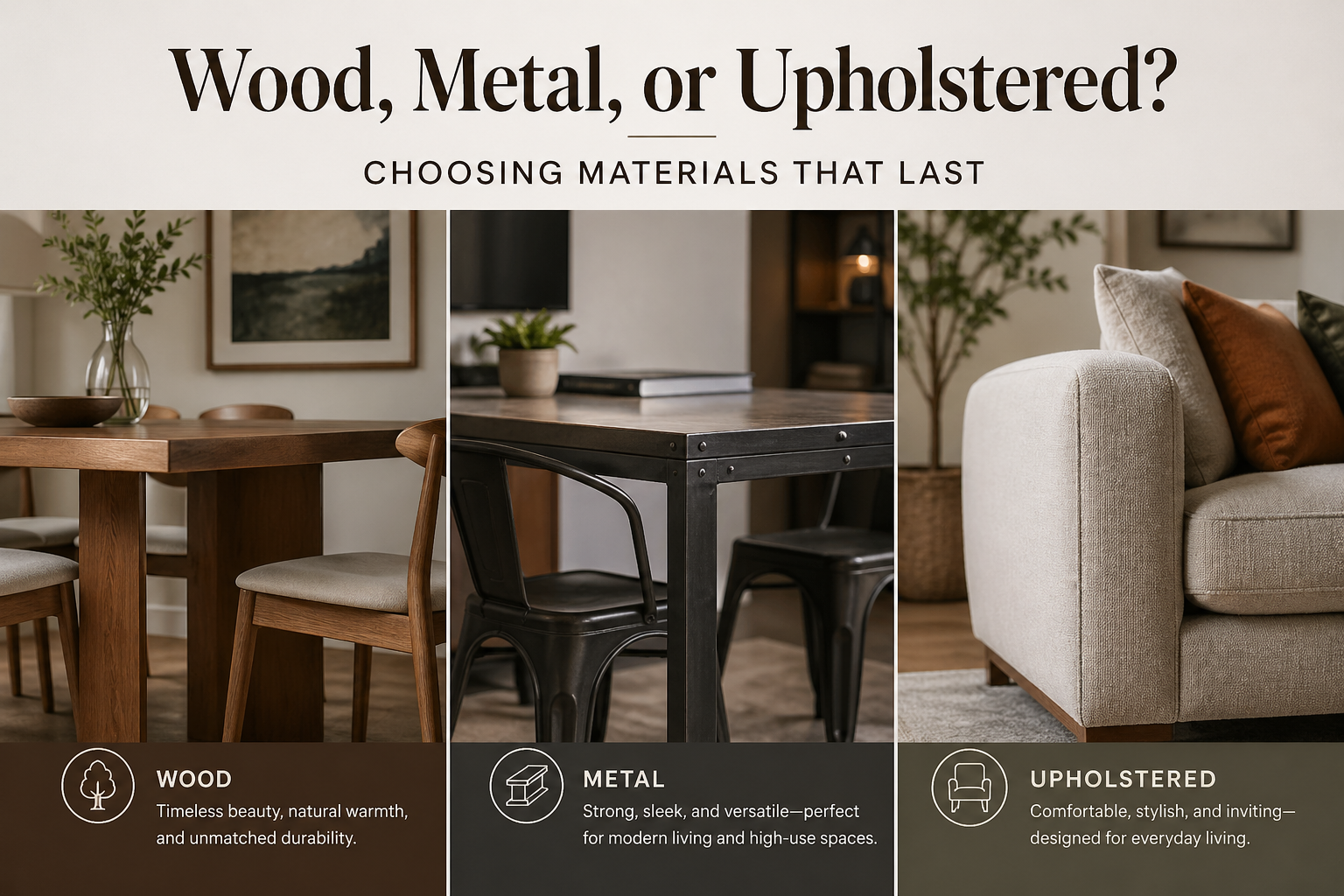
Materials are where furniture decisions go wrong most often — and not in the ways people expect.
It’s rarely a case of choosing something ugly. It’s a case of choosing something beautiful that turns out to be wrong for how you actually live. The pale linen sofa in a house with young children. The light finish dining table that shows every scratch from the first week. The velvet armchair that looks stunning in a showroom photograph and collects pet hair in a way that makes it unusable in practice.
The right material is not the most expensive one, and it’s not always the most photogenic one. It’s the one that suits your life, your space, and the next twenty years. Getting that decision right starts with understanding what your options actually are — not just how they look, but how they perform.
Wood
Wood is the most versatile furniture material available, and the most enduring. Used well, a solid wood piece will outlast almost everything else in a home — including the people who bought it. But not all wood is the same, and the differences matter.
Solidwood
Solid wood is the benchmark against which other materials are measured. The most common species used in furniture in the INDIA are teak, rosewood, walnut, ash, and mango wood each with distinct characteristics worth understanding.
Teak is the most popular choice for a reason: it is hard, durable, takes stain and oil well, and ages beautifully. A solid teak piece develops a warm patina over decades that makes it look better, not worse, with age. It suits everything from contemporary to traditional interiors.
Walnut is richer and darker, with a fine, straight grain that suits more refined or considered interiors. It is slightly softer than oak but still extremely durable. Walnut furniture tends to feel more luxurious and commands a premium accordingly.
Ash is pale, strong, and less widely used than oak — which makes it a distinctive choice. It takes stain particularly well and is well-suited to contemporary designs where a lighter wood tone is wanted without the ubiquity of pine.
Pine is softer and more affordable. It’s better suited to painted finishes than natural ones, and it marks more easily than hardwoods — which some people find characterful and others find frustrating. Well-suited to relaxed, informal, or country-style interiors.
The defining advantage of solid wood over every other material is reparability. Scratches can be sanded out. Joints can be re-glued. Surfaces can be re-oiled or re-stained. A well-made solid wood piece is not just durable — it is restorable. That is a quality almost nothing else in the furniture world can match.
Engineered wood: plywood, MDF, and veneered board
Engineered wood gets a poor reputation — largely because it is misused. Used correctly, it is a legitimate and sometimes preferable material. Used as a cost-cutting substitute for solid wood in structural roles, it fails quickly and visibly.
Plywood is made from layers of wood glued with alternating grain directions, which gives it exceptional strength and stability. It is actually preferable to solid wood for certain applications — cabinet backs, drawer bases, panel doors — because it resists warping better. High-quality birch or oak-faced plywood has a clean, contemporary aesthetic that works well in modern interiors.
MDF (medium-density fibreboard) takes paint beautifully, machines cleanly, and produces a perfectly smooth finish that solid wood cannot always match. It is a legitimate choice for painted cabinetry, built-in units, and contemporary furniture with a painted finish. It is not suitable for structural joints, exposed edges in wet areas, or anywhere requiring the visual warmth of natural wood.
The problems arise when engineered wood is used as a cheap substitute for solid wood in the frame, legs, or structural elements of a piece — places where its limitations in strength and moisture resistance become quickly apparent.
Questions to ask your maker
- Is the frame solid wood or engineered? Which species?
- How are the joints made — mortise and tenon, dowel, or cam lock?
- What finish is on the wood, and how should I maintain it?
Metal
Metal plays two distinct roles in furniture: structural and decorative. Understanding the difference helps buyers make significantly better decisions — particularly when it comes to hardware and surface finishes where quality variation is hardest to spot.
Steel and iron
Welded steel is one of the strongest structural materials used in furniture. A well-made steel table base or chair frame will outlast a timber equivalent by a significant margin, and it offers a visual lightness — thin section, clean line — that solid wood legs cannot always achieve.
The vulnerability of steel is its finish. Raw steel will rust if the protective coating is compromised. Powder coating — where a dry powder is electrostatically applied and then cured under heat — is the most durable finish for steel furniture and is far more resistant to chipping and scratching than wet paint. When specifying steel furniture, always ask about the finish and how damaged areas should be treated.
Brass and bronze
Brass has become one of the most popular accent materials in interior furniture over the past decade, appearing on legs, handles, hinges, and structural details. Its appeal is its warmth and its behaviour over time: solid brass develops a natural patina that most people come to love, giving pieces a sense of age and character that synthetic finishes cannot replicate.
The critical distinction is between solid brass and brass-plated finishes. Brass plating — a thin layer of brass applied over steel or zinc — looks identical to solid brass when new. It wears through at contact points within a few years, revealing the base metal beneath. On hardware used daily — drawer pulls, cabinet hinges, leg ferrules — this distinction matters considerably over the life of a piece.
Aluminium
Lightweight, rust-proof, and well-suited to outdoor furniture and certain contemporary indoor applications. Less common in interior furniture than steel or brass, but worth considering for pieces that need to be moved regularly or used in rooms with humidity variation.
Questions to ask your maker
- Is that brass solid or plated? What’s the base metal?
- What finish is on the steel — powder coat or wet paint?
- How should I maintain the metal finish over time?
Upholstery
Upholstery is the most lifestyle-dependent material category. The right choice depends less on aesthetic preference than on how a household actually functions — who uses the furniture, how often, and under what conditions.
Fabric
Fabric upholstery spans an enormous range, from sheer linen to heavy wool, from synthetic performance weaves to silk velvet. The practical questions to ask are about durability and clean-ability, both of which are quantifiable.
Rub count — the number of times a fabric can be abraded before showing wear — is the standard measure of fabric durability. Domestic use typically requires a minimum of 15,000 rubs; heavy domestic use (families, pets, daily use) warrants 25,000 or above. Most fabric suppliers will provide this figure on request.
- Performance fabrics (tightly woven, often treated for stain resistance) are the practical choice for homes with children, pets, or high-use seating. They have improved dramatically in recent years and many are genuinely beautiful as well as durable.
- Linen and cotton are natural, beautiful, and well-suited to occasional seating or calmer households. They mark more easily than performance weaves, fade in direct sunlight, and typically require dry cleaning rather than spot cleaning.
- Velvet is luxurious but demanding. It shows indentation marks from use (though these brush out), is difficult to clean thoroughly, and tends to attract pet hair. Best reserved for pieces that will be used carefully and infrequently.
- Wool is durable, warm, and naturally resilient — an underrated choice. It ages well, resists pilling better than many synthetics, and suits both contemporary and traditional interiors. Specialist cleaning is usually required.
Leather
Full-grain leather is one of the most durable upholstery materials available, and one of the most rewarding to live with. It softens and develops character over years of use, is easy to wipe clean, and is genuinely more practical than many fabric alternatives for high-use pieces.
The quality distinction in leather is significant and not always visible to the untrained eye. Full-grain leather retains the natural surface of the hide, including its inherent markings — these are not flaws but evidence of authenticity. Corrected-grain leather has been sanded and coated to produce a more uniform surface; it is less durable and develops less character over time. Bonded leather — leather fibres compressed with polyurethane binding — looks similar to genuine leather when new and peels or cracks within a few years of regular use.
Leather does have real limitations: it is cold to the touch in winter, warm in summer, and requires periodic conditioning to prevent drying and cracking. In very sunny rooms, it can fade. These are manageable considerations, not reasons to avoid it — but they are worth knowing.
The fill question
What is inside a cushion matters as much as what covers it — and it is the question buyers almost never ask. High-resilience foam holds its shape over years of daily use; low-density foam compresses within months and is responsible for the ‘sunken’ sofa feeling that leads to early replacement.
Feather and fibre wrapping around a foam core adds softness and a more relaxed silhouette without sacrificing support. Loose feather-filled cushions are the most luxurious but require the most maintenance — they need regular plumping to maintain their shape.
Questions to ask your maker
- What is the rub count on that fabric?
- Is the leather full-grain, corrected-grain, or bonded?
- What is the foam density in the seat cushions?
- Is there a feather wrap, or foam only?
Mixing materials well
The most enduring furniture pieces often combine more than one material. A walnut dining table with a powder-coated steel base. A linen sofa with solid tea feet and brass leg ferrules. A painted cabinet with aged brass hardware. These combinations work because the materials complement rather than compete.
The practical principle is to contrast by weight and warmth. Pair a warm material — wood, leather, linen — with a cooler one — steel, stone, glass — for balance. Avoid pairing two materials that share the same quality: two shiny surfaces, two rough textures, two pale tones. Contrast is what gives a piece depth.
Material mixing is one of the areas where commissioning custom furniture has a distinct advantage over buying off-the-shelf. The combination can be considered and designed from the outset, rather than assembled from separate purchases that may not quite work together.
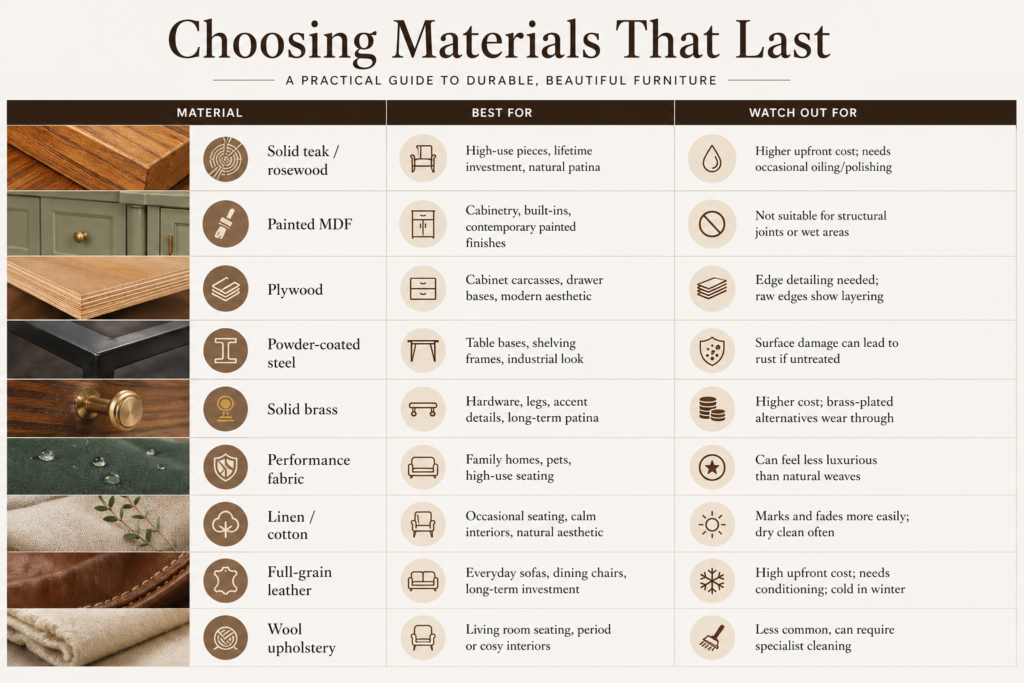
Quick reference: materials at a glance
Know what you want. Let’s make it.
Once you know which materials suit your life and your space, the next step is finding a maker who can combine them well — someone who understands not just how materials look, but how they perform, how they age, and how they work together over the long term.
→ Want to see materials in person? Visit our showroom.
→ Ready to talk through your project? Book a free consultation — bring your ideas and we’ll find the right combination for how you live.
The right material isn’t the most expensive one. It’s the one that suits your life, your space, and the next twenty years.